The black and white American flag strips away the familiar red, white, and blue — and replaces it with something starker. No celebration. Just contrast.
Depending on who's flying it, this flag can mean mourning, tribute to first responders, political protest, or simply a bold aesthetic choice. It's one of the most emotionally loaded flag designs in modern America, and its meaning shifts depending on the stripe — or lack of one.
This guide covers everything: the origins, what each version represents, the controversies, and how to choose the right one.
What Is the Black and White American Flag?
You’ve probably seen it before — a bold, colorless take on the Stars and Stripes.
No red, no blue. Just black and white.
So what does the black and white American flag mean?
Depending on who’s flying it, the answer could be patriotism, protest, mourning, or rebellion. In a time when flags speak louder than ever, the black and white version has become one of the most emotionally charged symbols in modern America.
Let’s break it all down. In this blog, we’ll delve into the origins, meanings, and variations of the American flag with black and white stripes, American flag black meaning, such as the black red white flag and the white flag with black stripe, to uncover what this unique design symbolizes, we also introduce Flagwix, a trusted provider of high-quality flags that allow you to display your values with pride.
The black and white American flag is a monochrome reinterpretation of the traditional Stars and Stripes. It keeps the same 50 stars and 13 stripes — but removes all color, leaving only black and white.
It's not an official government flag. It's a symbolic variation, and its meaning is entirely defined by context and community.
You'll commonly see it on:
- Uniform patches and tactical gear for first responders
- Memorial tattoos and car decals
- Home décor and apparel
- Protests, rallies, and political demonstrations
Looking for one? Browse Flagwix's Black & White American Flag — canvas construction, UV-resistant, available in multiple sizes.
Origins: Where Did the Black and White American Flag Come From?

The black and white striped American flag has its roots in both historical myth and modern innovation. Its meaning has evolved over time, shaped by cultural, artistic, and political movements.
1. Civil War Myths
One of the earliest stories about the white flag with black stripe ties it to the Civil War (1861–1865). According to some accounts, Confederate soldiers used us flag in black to signify their unwillingness to surrender or take prisoners. The USA black flag meaning, in this context, symbolized defiance and a commitment to fight to the bitter end. However, there is little historical evidence to substantiate these claims. Confederate forces primarily used their own battle flags, while Union soldiers adhered strictly to the traditional red, white, and blue “Old Glory.”
However, despite its origins, today the black and white American flag means much more than that.
The U.S. flag black and white is simply black and therefore the stars and stripes are difficult to recognize. The black and white versions are easier to distinguish, but both are recognized as the same flag.
2. Jasper Johns and the art world (1955)
The first well-documented black and white American flag appeared in 1955, when Pop Art pioneer Jasper Johns painted the Stars and Stripes in monochrome. His goal was to strip away the flag's emotional charge and force viewers to see it as a shape and form rather than a symbol.
That artistic reframing had lasting impact. The black and white flag moved from galleries into activism, fashion, and everyday patriotism — carrying a different emotional weight than the original.
3. Modern use (1990s–present)
The Thin Blue Line flag — a black and white American flag with a single blue stripe — emerged as a law enforcement tribute in the 1990s and surged in visibility after 2014. From there, the design spread: red stripes for firefighters, yellow for dispatchers, green for military and border patrol.
Today, the black and white flag exists in dozens of variations, each with its own distinct community and meaning.
🏴 What Does the Black and White American Flag Represent?

The meaning depends almost entirely on which version you're looking at.
No stripe: Mourning, tribute, and remembrance
A plain black and white American flag — no colored stripe — typically represents grief, mourning, or a solemn tribute. It's used at memorial services, by military families, and by veterans' groups to honor the fallen.
This version tends to be seen as non-political. It's a way of saying we remember without aligning with any particular cause or movement.
Where you'll see it: Memorials, veteran ceremonies, some home displays.
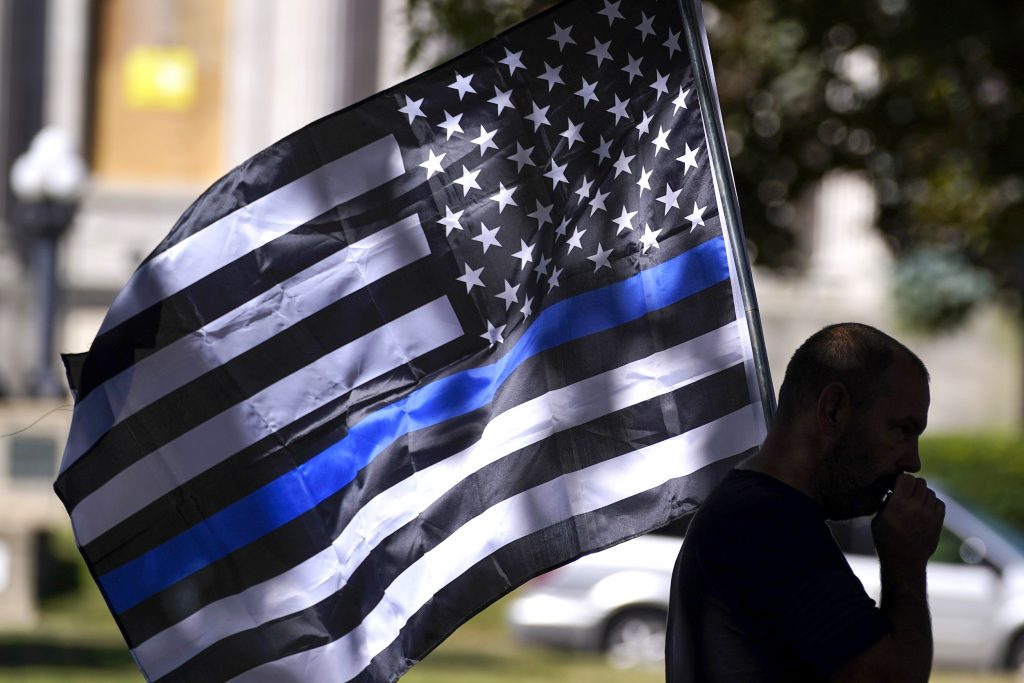
Blue stripe: The Thin Blue Line flag
The black and white American flag with a blue stripe is one of the most recognized — and most debated — flag variations in the country.
What supporters say: The blue stripe represents law enforcement officers. The black on either side honors fallen officers. Flying it is a tribute to police bravery and sacrifice.
What critics say: After 2014 and the rise of racial justice protests, the Thin Blue Line flag became associated with opposition to police accountability movements. Critics argue it's been co-opted as a counter-symbol to Black Lives Matter.
The flag itself predates those associations, but the controversy is real — and worth understanding before displaying it.
Where you'll see it: Police vehicles, uniform patches, firearm accessories, tattoos, front yards.
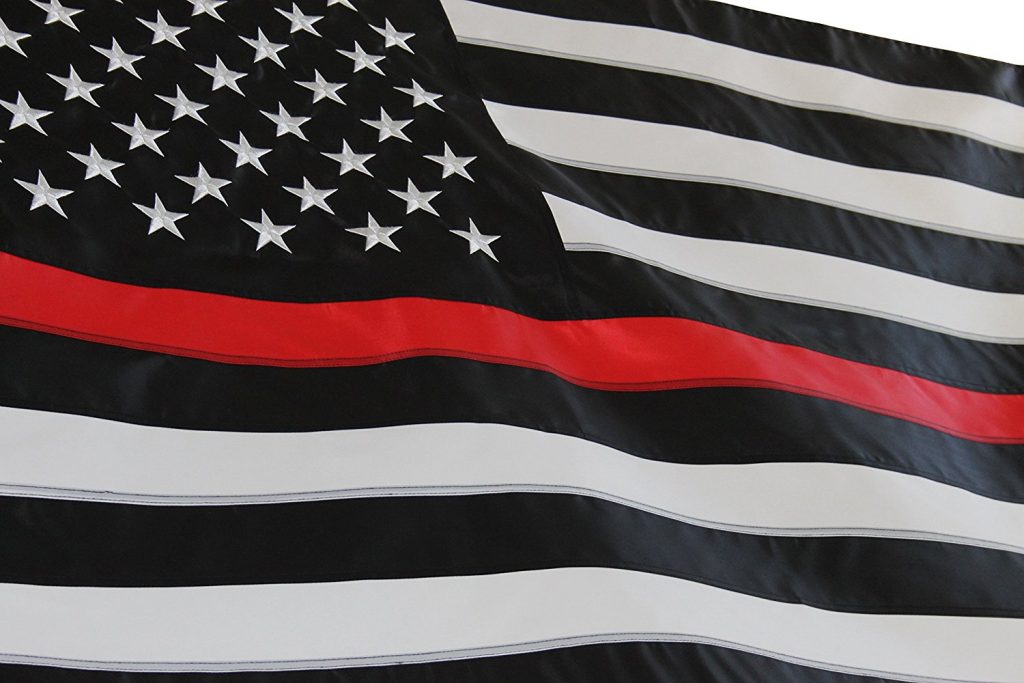
Red stripe: The Thin Red Line flag
The black and white American flag with a red stripe honors firefighters and paramedics. Known as the Thin Red Line flag, it acknowledges the people who run toward burning buildings.
It appears at firehouses, memorial events, and on first responder gear. Unlike the blue stripe version, it has remained relatively free of political controversy.
Where you'll see it: Fire stations, first responder apparel, memorial patches, tattoos.
Yellow stripe: The Thin Gold Line flag
Less well-known but growing in recognition, the yellow stripe version — sometimes called the Thin Gold Line — honors emergency dispatchers, private security, search and rescue teams, and tow truck operators.
These are the behind-the-scenes roles that rarely get public recognition. The gold line flag is a way of saying their work matters too.
Where you'll see it: Emergency communication centers, dispatch unit patches, support gear.
Green stripe: The Thin Green Line flag
The green stripe flag recognizes military personnel, border patrol agents, park rangers, and federal conservation officers. It's used to show support for those who serve in federal law enforcement and defense roles that don't fall under local police or fire departments.
Where you'll see it: Military households, border patrol communities, outdoor and conservation groups.
Distressed or upside-down: Protest and defiance
A tattered, weathered, or upside-down black and white American flag carries a different message entirely.
The U.S. Flag Code states that flying any flag upside down is a recognized signal of dire distress — originally meant for emergencies at sea or in the field. In modern use, it's been adopted as a form of protest, signaling that the nation itself is in crisis.
Movements across the political spectrum have used this version: libertarians, anti-government activists, progressive protesters, and others who want to express that something fundamental is wrong.
Where you'll see it: Protests, political demonstrations, social media activism.
Quick Reference: All Versions at a Glance
| Version | Meaning | |
|---|---|---|
|
|
No stripe plain black & white | Mourning, memorial, tribute to the fallen |
|
|
Blue stripe Thin Blue Line | Law enforcement support |
|
|
Red stripe Thin Red Line | Firefighter and paramedic tribute |
|
|
Yellow stripe Thin Gold Line | Dispatchers, security, emergency communications |
|
|
Green stripe Thin Green Line | Military, border patrol, federal law enforcement |
|
|
Distressed / upside-down | Protest, national distress, defiance |
Shop related flags at Flagwix
|
|
|
||||||
|
|
|
Originally, this flag is seen as a symbol of respect and remembrance. It removes the traditional red, white, and blue colors to honor the fallen — especially in military and law enforcement communities.
🔲 What the colors (or lack thereof) represent:
-
Black: Sacrifice, mourning, or sometimes resistance.
-
White: Peace, silence, or contrast.
-
The Flag Overall: A tribute stripped of color, leaving only the form.
It’s a version of the U.S. flag with different emotional weight — and its meaning shifts depending on who’s flying it and why.
⚠️ Protest & Rebellion: A Flag of Defiance
The distressed or tattered black and white American flag, especially when flown upside down, has become a symbol of civil unrest, rebellion, or belief that America is in distress.
🆘 Flag Code:
“Displaying the flag upside down is a signal of dire distress in instances of extreme danger to life or property.”
🧨 Used by:
-
Political activists
-
Libertarian groups
-
Protesters on both ends of the political spectrum
One of the most common uses of the United States flag black and white is as a symbol of protest. The lack of color can represent disillusionment or mourning for the loss of certain ideals, such as equality or justice.
Movements like Black Lives Matter have utilized this flag to call attention to systemic issues and to advocate for social change. In this context, the black and white flag stands as a powerful reminder of the work still needed to achieve a just society.
Flying a flag upside down is no accident — it’s a recognized distress signal with serious meaning. Learn more about why people fly the American flag upside down and what it legally and culturally represents today.
👉 Read more: Black Lives Matter and the story behind it
👉 Check out the Black Lives Matter Flag Collection at Flagwix
Flagwix™ Black History Month Flag – A Heritage Of Unshakable Faith
On Sale: from $27.95
- Size: Available 3 sizes: House Flag, Garden Flag, 3 x 5 ft. Flag
- Material: Canvas
- UV and mildew resistance
- Double sides printed
Flagwix™ Black History Month Flag
On Sale: from $27.95
- Size: Available 3 sizes: House Flag, Garden Flag, 3 x 5 ft. Flag
- Material: Canvas
- UV and mildew resistance
- Double sides printed
Flagwix™ Black History Month Flag I Am Black Every Month Blackity Black Flag
On Sale: from $27.95
- Size: Available 3 sizes: House Flag, Garden Flag, 3 x 5 ft. Flag
- Material: Canvas
- UV and mildew resistance
- Double sides printed
🕊️ Mourning & Tribute: A Silent Salute
A significant variation of the black and white American flag incorporates colored stripes to honor specific professions.
These variations give the USA flag black and white a new layer of meaning, turning it into a versatile symbol of respect and gratitude.
In many military homes or memorial ceremonies, the black and white American flag without any stripe is used purely to honor fallen soldiers, veterans, or first responders.
- Often seen as non-political
- A simple way to say: “We remember.”
The black and white flag is often flown to honor those we’ve lost — but did you know flying a flag at half-staff also carries deep significance? Here’s what it means and why flags are lowered across the U.S. during times of national mourning.
🎨 Style or Statement?
Let’s not forget — not every display of the black and white flag is political or emotional.
Some fly it for:
-
Aesthetic: Monochrome style for home decor, streetwear, or vehicle decals.
-
Design: Tattoo art, clothing, and brand identity.
-
Neutral Patriotism: Still love the flag, just prefer the tones.
If you’re displaying any version of the American flag as part of your home decor, it’s worth reviewing the official U.S. flag decor guidelines. They’ll help you stay respectful while showing your patriotism in style.
🔍 Related Flags: Yellow, Red, Green Stripes?
There are many black and white flags with color variations now in circulation:
-
🔴 Red Stripe = Firefighters
-
🟡 Yellow Stripe = Dispatch/Private Security
-
🟢 Green Stripe = Military personnel
-
🔵 Blue Stripe = Police
⚠️ These variants are not official, but have grown popular in first responder and patriotic circles.
Thin Red Line (Black Red White Flag)

The fire department is represented by the thin red stripe on the black and white American flag. The red stripe on the American flag has recently been associated with the concept of “red life matters.” This suggests that all lives in the fire are valuable and must be preserved at any cost.
A black and white American flag with a red stripe is used to honor firefighters and paramedics. Known as the Thin Red Line flag, this version acknowledges those who risk their lives to protect people and property.
This flag appears in:
-
Firehouses
-
Memorial events
-
First responder apparel
-
Tattoo designs
It’s one of the most respectful ways to silently say: We remember and honor your sacrifice.
The United States red flag is used to show support for the department, but it is also used to remember injured or deceased firefighters.
And Flagwix also has FireFighter Flags:
🟡 Black and White American Flag With Yellow Stripe (Thin Gold Line)
Less common but rising in awareness, the black and white American flag with a yellow stripe is used to recognize:
-
Emergency dispatchers
-
Private security
-
Search and rescue teams
-
Tow truck operators
While not as mainstream as the blue or red stripe versions, this flag is a symbol of appreciation for those who serve behind the scenes.
You may spot this version on:
-
Emergency gear
-
Support banners
-
Special patches for dispatch units

Black and White American Flag With Green Stripe (Thin Green Line)

The green line is a symbol of support for federal law enforcement agents such as border patrol, park rangers, and conservation personnel.
All armed forces in the United States are represented by a thin green border on the flags.
It was also often printed on apparel, accessories, and souvenirs. It features an image of an American flag with a green stripe in the center, indicating any individual’s support for the US military.
🔵 Black and White American Flag With Blue Stripe (Thin Blue Line)
One of the most well-known forms is the black and white American flag with a blue stripe — often called the Thin Blue Line flag.
🟦 What it means:
-
The blue line represents law enforcement officers.
-
The black background stands for the fallen.
-
Symbolizes the “thin blue line” between order and chaos.
🔥 Controversial Take:
-
Supporters see it as a tribute to police bravery.
-
Critics view it as a political counter-symbol to racial justice movements.
This flag is commonly displayed on:
-
Police vehicles
-
Uniform patches
-
Tactical gear
-
Memorial tattoos
The “thin blue border” of the US flag also denotes police enforcement. They are hung to demonstrate solidarity with all residents, male and female, who have given up their peaceful lives to help protect everyone.
This Thin Blue Line Police Law Enforcement American Eagle Flag represents compassion and support for America’s police officers.
The Cultural Significance of the Black and White American Flag
The black and white American flag is more than just an alternative design—it’s a reflection of America’s evolving cultural and political landscape. It has been adopted and utilized in a variety of contexts:
In social movements
The plain black and white flag has been used by activists to convey a somber seriousness — stripping away the celebratory colors of the original flag to make a point about unfinished justice. Movements focused on racial equality and police accountability have incorporated it into protests and memorial marches.
In art and pop culture
Jasper Johns' 1955 monochrome flag kicked off a tradition of the black and white flag appearing in fine art, streetwear, tattoo culture, and graphic design. Its minimalist aesthetic translates across media in a way the full-color flag doesn't — it photographs well, reads clearly in black and white print, and carries visual weight without color dependency.
In everyday patriotism
Not every black and white flag is a political statement. Many people display it simply because they prefer the aesthetic — a more subdued, modern take on patriotism that fits certain home styles better than the traditional red, white, and blue.
Curious how color impacts flag symbolism in other countries? Check out our breakdown of the green, white, and orange flag and what it really stands for. You’ll be surprised how often similar color patterns carry totally different meanings across the world.
Why Fly a Black and White American Flag?
Whether it’s flown at a rally, displayed in a home, or worn as a patch, the black and white American flag serves as a powerful form of expression. Here are some reasons why people choose to fly this flag:
• To Support First Responders: Honoring those who dedicate their lives to public safety.
• To Advocate for Change: Standing in solidarity with movements that fight for justice and equality.
• To Make a Personal Statement: Using the flag to represent individual values or artistic expression.
• For Its Aesthetic Appeal: Adding a minimalist and modern touch to personal spaces.
Is It Legal to Fly a Black and White American Flag?
Yes. The U.S. Flag Code only regulates the official red, white, and blue flag. Variations like the black and white version, the Thin Blue Line flag, and other stripe designs are not governed by federal flag law.
There are no federal penalties for displaying them. Some local ordinances or HOA rules may restrict flag displays generally — it's worth checking those if relevant — but the black and white flag itself is entirely legal.
FAQs About the Black and White American Flag
1. What does a black and white American flag mean?
It often symbolizes mourning, memorial, protest, or solidarity — depending on the style and context.
2. Does the black and white flag violate the U.S. Flag Code?
No. The U.S. Flag Code only applies to the official red, white, and blue flag. Variations like the black and white flag are considered symbolic and decorative.
3. What is the Thin Blue Line flag?
The Thin Blue Line flag is a black and white American flag with a single blue horizontal stripe. It's used to show support for law enforcement and to honor fallen police officers. It has become politically controversial in recent years due to its association with debates around policing and racial justice.
4. What does an upside-down black and white flag mean?
Displaying a flag upside-down has traditionally been recognized as a symbol of distress. Some use the upside-down black and white flag as a form of protest or to express dissatisfaction with the state of the nation.
5. Can I fly a black and white American flag at home?
Yes. There's no federal law against it. Check local ordinances or HOA rules if applicable.
6. Is the black and white American flag disrespectful?
Not inherently. Its meaning depends on intent and context. The Thin Blue Line and Thin Red Line versions are widely seen as respectful tributes. The upside-down version is intentionally provocative. A plain black and white flag used for memorial purposes is generally considered respectful.
Where to Purchase the Black and White American Flag?
If you’re inspired by the symbolism and versatility of the black and white American flag, Flagwix is the perfect place to find one. As a trusted online store, Flagwix offers a wide variety of decorative flags crafted with exceptional quality. Their collection includes:
- Thin Line flags for honoring first responders.
- Customizable flags for unique personal expression.
- Seasonal flags and patriotic flags for year-round celebrations.
If you’re ready to own a flag that represents your values, explore the extensive collection at Flagwix. Display your pride, make a statement, and join a growing community of people who appreciate the depth and beauty of the black and white American flag.
And don’t forget that Flagwix has more regular updates for Memorial Flags, Patriotism Flags, 250th flags, and more, v.v.
Explore our full range of decorative flags for your home decor.