History & Context
The Christian Crusader Flag: History, Meaning & Modern Controversy
The Christian Crusader flag is a symbol with deep historical roots and a complicated modern legacy. This is an honest, complete look at where it came from, what it has represented, and why it remains controversial today.
Quick Answer: The Christian Crusader flag — typically a red cross on a white field — originated with the medieval Crusades, where it represented a religious-military campaign. Over time it has been read as a symbol of valor and faith, but in the modern era it has been adopted by hate groups, giving it deeply controversial associations. It is entirely distinct from the official Christian Flag of 1897, which symbolizes faith, hope, and love.
Few flags carry as layered a history as the Christian Crusader flag. To understand it fully, you have to look at three very different chapters: its medieval origins, the meanings later attached to it, and the troubling ways it has been used in modern times. This guide walks through each honestly.
Medieval Origins of the Crusader Flag
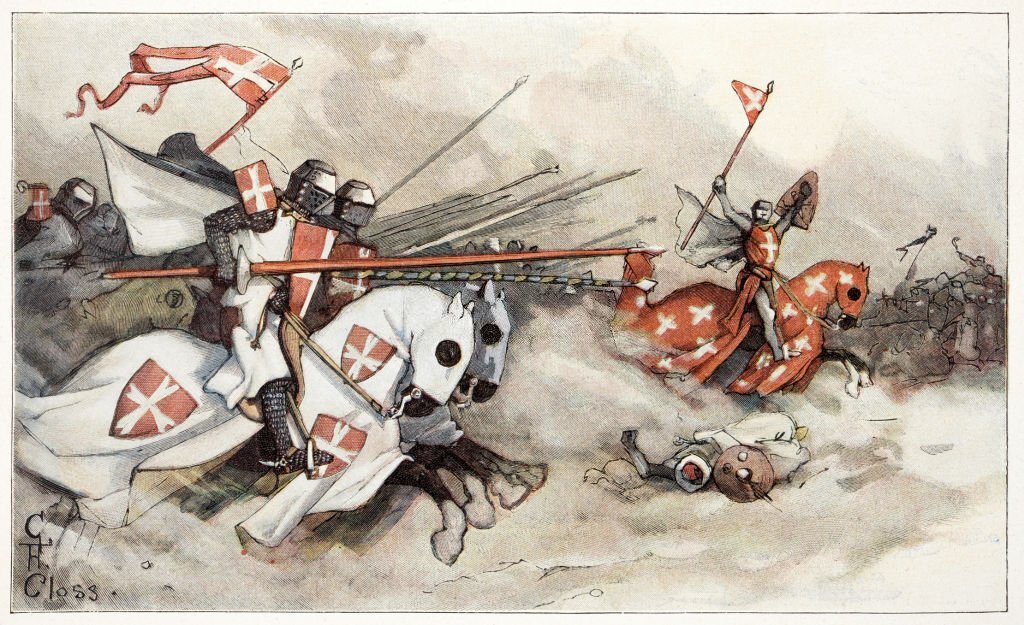
The imagery now called the “Christian Crusader flag” traces back to the medieval Crusades, a series of religious wars fought roughly between the 11th and 13th centuries. During this era, a red cross on a white background was worn and carried by certain Crusading forces to identify combatants engaged in a campaign framed in religious terms.
The cross itself is among the most ancient Christian symbols, but the specific Crusader banner is tied to this particular and heavily contested chapter of history. It was a battlefield emblem, not a peaceful expression of worship.
How the Symbol Has Been Interpreted
Over the centuries, some have viewed the Crusader cross as a symbol of valor, perseverance, or religious conviction, drawing on a romanticized image of the medieval knight. But because the Crusades themselves were violent military campaigns, the banner has always carried connotations of conflict — and those connotations have made it easy to misuse.
A Troubling Modern Legacy
In the modern era, Crusader imagery has been appropriated by hate groups and white-supremacist movements. Historically, organizations such as the Ku Klux Klan adopted cross-based imagery, and a red cross on a white field has been displayed alongside other symbols of intolerance, including the Confederate battle flag.
More recently, Crusader and “holy war” imagery has resurfaced at extremist gatherings — for example, far-right demonstrators displayed such symbols at the 2017 “Unite the Right” rally in Charlottesville, Virginia. Because of this pattern of appropriation, many people today encounter the Crusader flag in hateful contexts rather than purely historical ones.
This association must be acknowledged plainly. When a symbol is used to promote hatred, bigotry, or division, that use should be named and rejected. A flag adopted to intimidate or exclude others stands against the values of equality and justice — and should be denounced by all who hold those values.
Important distinction: The Christian Crusader flag should never be confused with the official Christian Flag, created in 1897, which features a blue canton with a red Latin cross on a white field. That flag was designed to unite Christians of all denominations under the principles of faith, hope, and love — and has no connection to the Crusader banner or to any hate movement.
Why Mainstream Christianity Does Not Embrace It
The overwhelming majority of Christians do not identify with the Crusader flag, and mainstream Christianity does not treat it as a representation of the faith. Christianity’s core teachings center on love, grace, and peace — values that stand in direct contrast to how the Crusader symbol has been used by extremist groups. For believers, the recognized emblem of faith is the 1897 Christian Flag, not the Crusader banner.
The Christian Flag Believers Recognize Today
For Christians who wish to express their faith through a flag, the widely recognized symbol is the 1897 Christian Flag — a peaceful emblem flown in churches, schools, and homes around the world. Unlike the Crusader banner, it carries a message of unity and shared belief across denominations.
To learn more, read What Does the Christian Flag Symbolize?, explore the earliest Christian symbols, or see our guide on displaying the Christian and American flag.